
A Price Cut Doesn't Mean the House Has a Secret: What Arizona Buyers and Sellers Should Know
Does a home price reduction mean something is wrong with the property? Learn why Arizona homes get price cuts, what buyers should look for, and how sellers can price strategically.
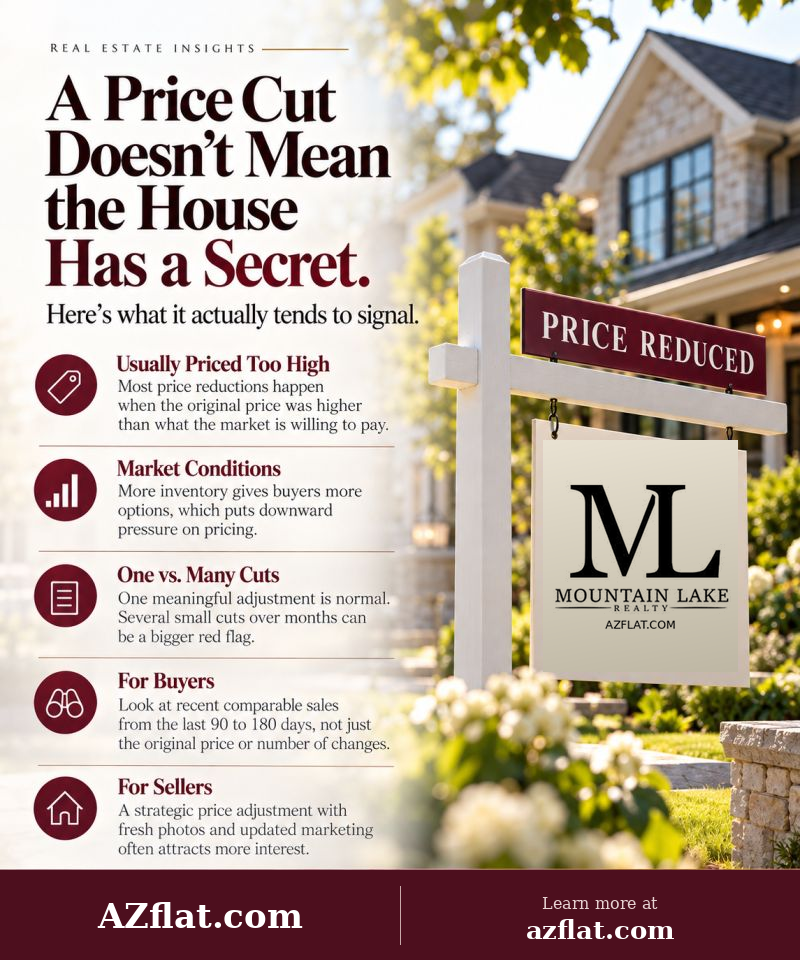
When an Arizona home listing shows a price reduction, buyers often wonder what is wrong with the property. Is the seller desperate? Did a home inspection uncover a serious problem? Has the house been sitting on the market too long?
These are reasonable questions, but a price reduction does not automatically mean a house has a hidden defect, a troublesome seller, or a problem that should scare buyers away.
In many cases, a price reduction reflects a much simpler explanation: the original asking price was higher than what the current market was willing to support.
Real estate pricing is influenced by comparable sales, competing listings, buyer demand, mortgage rates, property condition, location, and the seller's expectations. When those factors do not align with the original asking price, an adjustment may become necessary.
For Arizona home buyers, understanding price reductions can reveal opportunities that other buyers overlook. For sellers, understanding why homes require price cuts can help prevent an expensive mistake before the property even reaches the market.
Whether you are buying or selling a home in Phoenix, Scottsdale, Mesa, Gilbert, Chandler, Peoria, or another Arizona community, the important question is not simply whether the price has changed — it is why the price changed and whether the current asking price represents reasonable market value.
1. The Most Common Reason for a Price Reduction: The Home Was Initially Overpriced
One of the most common explanations for a residential price reduction is that the original asking price was too high for the market.
Sellers naturally want to receive the highest possible price for their property. They may have invested thousands of dollars in renovations, maintained the home carefully, or watched a neighboring property sell for an impressive amount. Those factors can influence a seller's expectations, but buyers evaluate homes differently.
Buyers typically compare a property against other homes they can purchase within the same budget. They consider location, square footage, bedrooms, bathrooms, lot size, condition, features, and recent comparable sales.
If several competing homes offer similar features at lower prices, an overpriced property may receive fewer showings and less serious interest. The seller might initially believe the asking price is justified. After several weeks without meaningful offers, however, the market may be communicating something different.
A price reduction can bring the property closer to the range buyers consider reasonable.
Why the original asking price matters
Imagine two similar homes in the same Arizona neighborhood. Home A is listed for $525,000. Home B is listed for $495,000. Both have comparable square footage, similar upgrades, and similar locations.
Unless Home A offers meaningful advantages, buyers may focus on Home B. Home A might still be worth $495,000 or even more, depending on the actual comparable sales and its condition. But the higher asking price could discourage potential buyers from scheduling a showing.
If the seller eventually reduces Home A to $499,000, the listing may attract renewed attention. This illustrates an important principle: a price reduction can correct an initial pricing mistake rather than reveal a problem with the house.
2. Arizona Market Conditions Can Change the Pricing Equation
Real estate is local. Conditions affecting a home in Phoenix may differ from those affecting a property in Prescott, Tucson, Flagstaff, or a smaller Arizona community. Even within the Phoenix metropolitan area, housing markets can vary by neighborhood, price range, property type, and buyer demand.
More homes for sale give buyers more choices
When inventory increases, buyers generally have more properties to compare. A seller who previously had few direct competitors may suddenly face several similar listings. Buyers can evaluate each property's price, condition, location, and features before deciding which homes deserve a showing.
In that environment, sellers may need to be more competitive. A home does not necessarily become less valuable simply because more properties are available. However, the seller may need to adjust the asking price or improve the home's presentation to stand out.
Mortgage rates affect purchasing power
Mortgage interest rates influence how much home many buyers can afford. When financing becomes more expensive, some buyers reduce their budgets, postpone purchases, or become more selective. Properties that previously attracted strong interest may receive fewer offers.
A seller who priced a home based on earlier market conditions may discover that today's buyers have different financial limitations. A price reduction can help bridge the gap between the seller's expectations and the amount buyers are prepared to spend.
Seasonal demand matters
Buyer activity can fluctuate throughout the year. Some Arizona sellers may experience stronger interest during particular seasonal periods, while other homes attract buyers throughout the year because of their location, price, or unique features.
However, seasonality is not a substitute for analyzing current market evidence. A seller should not assume that waiting for a particular month will automatically produce a higher price. The appropriate response depends on local inventory, comparable sales, competing properties, and the individual home's circumstances.
3. One Price Reduction Is Different From Repeated Price Cuts
Not all price reductions tell the same story.
A single, meaningful price adjustment may indicate that a seller has reconsidered the original asking price and is now trying to attract a broader group of buyers. Repeated reductions over several months can suggest that the property's pricing strategy has not been effective.
Consider two hypothetical Arizona listings:
- Property A: Listed at $550,000. After reviewing competing listings and receiving limited interest, the seller reduces the price to $525,000.
- Property B: Begins at $575,000, drops to $565,000, then $550,000, and eventually $530,000.
Neither pattern proves that the property has a defect. The homes may be perfectly sound. However, Property B's repeated reductions may prompt buyers to investigate why the listing has struggled to attract an acceptable offer.
Possible explanations include an unrealistic initial price, unfavorable competition, limited marketing exposure, presentation problems, property-condition concerns, or changing seller circumstances.
The key is to distinguish between a pricing history and evidence of an actual property problem. A seller should consider whether one well-supported adjustment would be more effective than a series of small reductions that prolong uncertainty.
4. What Buyers Should Investigate Before Making an Offer
A price reduction can create an opportunity, but buyers should evaluate the property rather than focus exclusively on the discount. A home that has been reduced by $30,000 is not automatically a better deal than a home that has never been reduced.
Review recent comparable sales
Comparable sales — often called comps — provide an important starting point for evaluating a property's asking price. Look for recently sold homes with similar characteristics, including:
- Location and neighborhood
- Living area and floor plan
- Number of bedrooms and bathrooms
- Lot size and property type
- Age, condition, and quality of improvements
- Pool, garage, views, and other significant features
A home that is priced below its original asking price may still be overpriced compared with similar properties that have actually sold. The most useful comparison is between the property's current asking price and the available market evidence — not simply the original price and the new price.
Examine the listing history
Buyers should review when the property was listed, how long it has been marketed, and whether the asking price has changed. A long marketing period can indicate that the property has not attracted an acceptable offer, but it does not establish why.
Listing history provides context. It does not replace an inspection or a careful review of the property's condition.
Pay attention to the home's condition
A price reduction should never replace appropriate due diligence. Buyers should evaluate the roof, heating and cooling systems, plumbing, electrical components, foundation, and other relevant features through appropriate inspections and professional evaluations.
Arizona buyers may also need to investigate issues involving roof wear from intense sun, aging air-conditioning equipment, drainage, pests, pools, or other property-specific concerns. Review available seller disclosures and ask questions about material concerns.
Determine whether the price reduction creates real value
Suppose a home was originally listed at $600,000 and is now offered at $565,000. That $35,000 reduction may look attractive. But if comparable homes have recently sold for approximately $540,000, the current price may still require negotiation.
The best opportunity is not necessarily the home with the largest price reduction. It is the home whose current price, condition, and location compare favorably with realistic alternatives.
5. Why Sellers Should Price Their Homes Correctly From the Beginning
An initial asking price establishes how buyers perceive a property when it first enters the market. If the price is supported by comparable sales and the home is presented effectively, the listing has a better chance of attracting attention from appropriately qualified buyers.
The cost of waiting for an unrealistic price
Suppose a seller believes a property should sell for $600,000, but the available market evidence supports a price closer to $565,000. The seller lists at $600,000 and receives limited interest. After several weeks, the asking price drops to $585,000. Additional time passes, and the seller eventually reduces it to $565,000.
The property may ultimately sell at a reasonable price, but the seller has spent additional time on the market. During that period, the seller may continue paying mortgage interest, property taxes, insurance, utilities, maintenance costs, and possibly HOA fees.
Why the highest initial price is not always the best strategy
Some sellers believe it is best to start high and negotiate downward. That approach can work in certain circumstances, but it is not automatically advantageous. Buyers may never consider a property that appears too expensive compared with alternatives.
The better strategy is to evaluate the competition, understand recent sales, and establish an asking price that supports the seller's objectives. The right price is not necessarily the lowest price — it is a defensible price that reflects the property's features and current market conditions.
6. Fresh Photos and Better Marketing Can Help After a Price Reduction
A price adjustment is one way to improve a listing's competitiveness, but it is not the only consideration. Sellers should also evaluate how effectively the property is being presented.
If the home has been on the market for an extended period, buyers may have already seen the original listing. Simply changing the price may not address every factor affecting buyer interest.
Depending on the circumstances, improvements could include:
- Professional real estate photography
- Better lighting and decluttering
- More effective descriptions of the property's features
- Highlighting useful upgrades and improvements
- Making appropriate repairs or addressing visible maintenance issues
Professional photography can help buyers understand the home's layout, condition, and appeal before scheduling a showing. Marketing cannot make an overpriced home a good value. But when pricing is reasonable, strong presentation can help the property compete more effectively.
7. Should a Seller Reduce the Price Again?
A seller who has already reduced the asking price may wonder whether another reduction is necessary. There is no universal rule requiring a price cut after a specific number of days. The appropriate timing depends on the property, local market activity, competition, and the seller's objectives.
Before making another adjustment, review the evidence:
- Evaluate showing activity. If very few buyers are scheduling showings, the asking price or online presentation may be discouraging interest.
- Evaluate buyer feedback. Feedback from showings may identify recurring concerns about price, condition, or features.
- Review competing listings. Understand what buyers can purchase for similar money.
- Compare the current price with actual sales. Recent closed sales generally provide stronger evidence of market value than asking prices alone.
If the evidence supports another adjustment, a meaningful change may be more useful than repeated small reductions that leave the property outside the range buyers consider competitive.
8. A Price Reduction Can Create an Opportunity for Negotiation
Buyers sometimes interpret a reduced asking price as an invitation to submit a very low offer. That may be appropriate in some circumstances, but the size of a reduction does not reveal the seller's minimum acceptable price.
A seller may have substantial equity and flexibility. Another may be facing a firm relocation deadline or have limited room to negotiate. Buyers generally cannot know the seller's financial position simply by reviewing a listing.
Instead, an offer should reflect the property's market value, the buyer's budget, competing properties, relevant contingencies, and the overall terms of the transaction. Negotiation works best when it is based on evidence rather than assumptions about why the seller reduced the price.
9. How Arizona Sellers Can Avoid Repeated Price Reductions
Arizona sellers can take several practical steps before listing to improve the chances of establishing a competitive asking price:
- Start with a realistic comparative market analysis. Examine recent sales of similar homes, along with current competition. Avoid relying exclusively on online estimates or a neighbor's asking price.
- Understand the property's strengths and limitations. A desirable location, updated kitchen, or usable outdoor space may support a higher price. Deferred maintenance or dated finishes may affect buyer demand.
- Prepare the property before photography. Clean, declutter, address visible maintenance issues, and make sure the home is ready to be presented accurately.
- Choose a pricing strategy before launch. Decide how the asking price relates to recent comparable sales and competing properties.
- Monitor the market after listing. Pay attention to showings, offers, buyer feedback, competing listings, and new comparable sales.
- Make decisions based on evidence. Avoid keeping an unrealistic asking price simply because of an emotional attachment to the property.
10. Selling an Arizona Home Does Not Have to Mean Paying a Traditional Listing Commission
Pricing is only one part of a successful home sale. Sellers should also understand the cost of the listing service they choose.
Traditional full-service real estate arrangements may include a listing commission calculated as a percentage of the home's sale price. Other licensed brokerages offer flat-fee MLS listing services, which can provide a different fee structure.
With a flat-fee MLS service, a seller typically pays an agreed fee for specified listing services rather than automatically paying a percentage-based listing commission. For Arizona homeowners, this creates another consideration when preparing a home for sale: understanding both the asking price and the cost of the selling arrangement.
AZflat.com provides information about flat-fee MLS listing options for Arizona home sellers. Sellers can review available services and determine whether a flat-fee approach fits their needs, budget, and desired level of involvement.
Saving on listing expenses does not eliminate the importance of competitive pricing, accurate disclosures, effective presentation, or a sound negotiation strategy. The objective is to understand the available options and choose a selling approach that supports your financial goals.
11. What Does a Price Reduction Really Tell You?
When buyers encounter a price-reduced property, they should consider several possible explanations. The seller may have initially overestimated the property's market value. Competing listings may have increased. Mortgage rates or buyer demand may have changed. The property may need updates, or the seller may simply have decided to adjust the asking price to attract more interest.
Sometimes, a price reduction reflects a seller's personal circumstances rather than a problem with the property. A reduction alone cannot establish which explanation is correct.
The asking price is a marketing decision. The property's condition and market value must be evaluated separately.
Frequently Asked Questions About Arizona Home Price Reductions
Does a price reduction mean something is wrong with the house?
No. A price reduction can reflect an unrealistic original asking price, increased competition, changing market conditions, or a seller's decision to attract more buyers. Buyers should investigate the property's condition through appropriate due diligence rather than assume that a reduction indicates a defect.
Is a home with a price reduction a better deal?
Not necessarily. The current asking price should be compared with recent sales, competing properties, the home's condition, and other relevant factors. A large reduction from an inflated original price may still leave a property overpriced.
How much should an Arizona seller reduce the asking price?
There is no single percentage that works for every property. The appropriate adjustment depends on comparable sales, competing listings, buyer activity, property condition, and the seller's objectives. A price change should be supported by market evidence rather than an arbitrary rule.
Should buyers make a low offer on a reduced-price home?
Buyers should base offers on market value, their financial limits, property condition, and the overall terms of the transaction. The size of a price reduction does not reveal the seller's minimum acceptable price or the property's actual market value.
How can Arizona sellers avoid needing a price reduction?
Start with a realistic asking price supported by recent comparable sales and current competition. Prepare the property carefully before listing. Monitor buyer activity and market conditions after launch. Make adjustments based on evidence rather than waiting for an extended marketing period to force a decision.
Thomas Mastromatto is a licensed Arizona real estate broker with 30 years of experience. Dash List Team at Mountain Lake Realty, License #BR104207000. This article is for informational purposes only and does not constitute legal, financial, or real estate advice. Consult a licensed professional for guidance specific to your situation.
Explore Topics
Written by
Thomas Mastromatto
Content creator and writer sharing insights and stories.