Should You Reduce the Price of Your Arizona Home or Wait for a Buyer?
When your Arizona home isn't getting offers, the hardest decision is whether to hold firm or adjust the price. Here is how to read the market and make the right call.
For Arizona homeowners, the hardest decision after listing a home may not be choosing the asking price. It may be deciding what to do when buyers don't respond to it.
Should you wait another few weeks?
Should you hold firm because you believe your home is worth the price?
Or should you make a price adjustment before the listing becomes stale?
There is no single answer for every Arizona home. But there is a useful way to look at the decision: let the market tell you what it is saying before time becomes your biggest problem.
The Arizona Housing Market Has Changed
Arizona homeowners are no longer selling into the same market that existed several years ago.
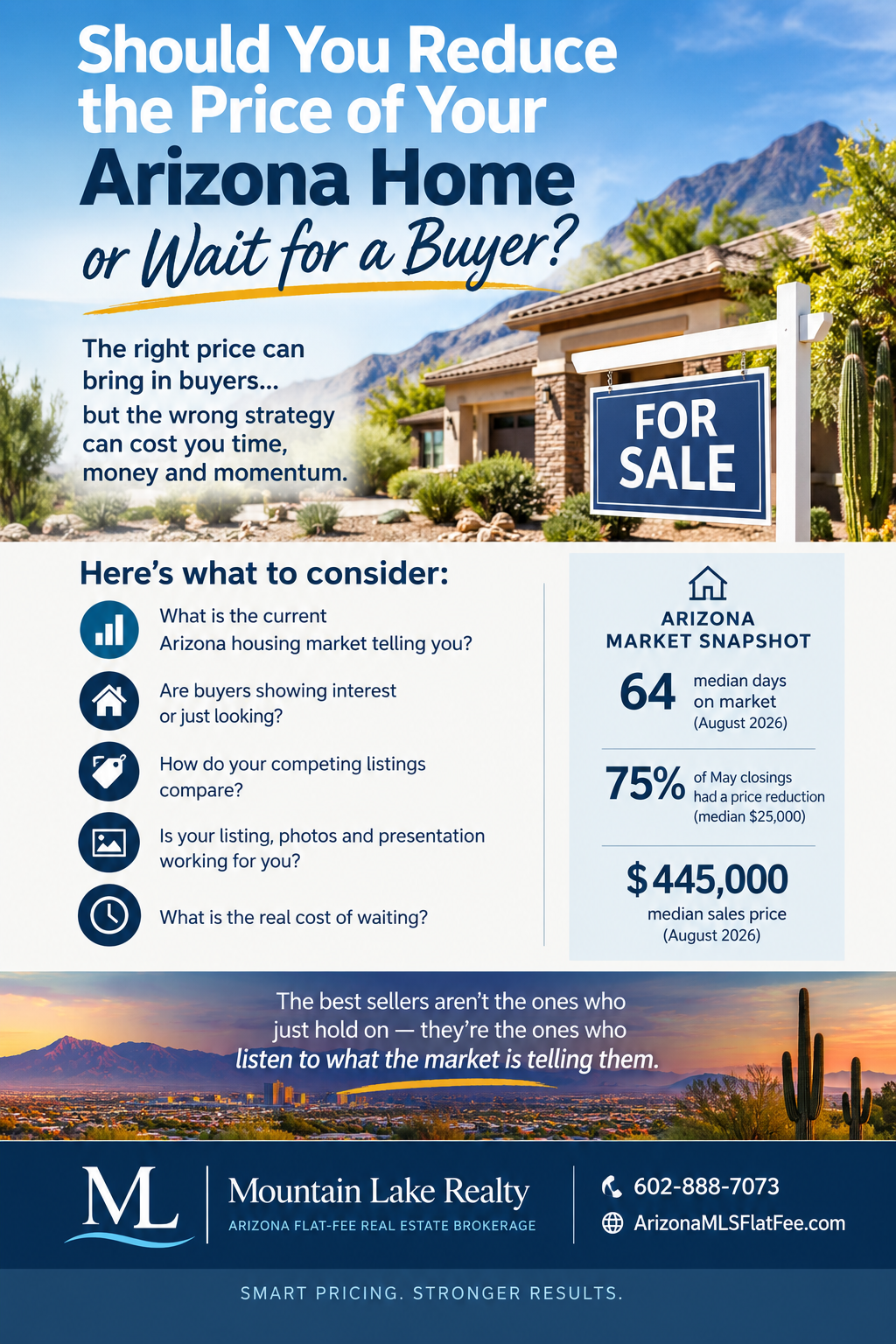
According to ARMLS, the median days on market in August 2026 was 64 days, compared with 67 days a year earlier. The median sales price was $445,000, while the median list price had fallen to $462,740.
One of the more important statistics for sellers is what happened before homes actually sold.
ARMLS reported that 75% of homes that closed in May 2026 had previously received a price reduction. The median reduction was $25,000.
That does not mean every Arizona seller should immediately cut the price.
It does mean that pricing strategy matters enormously.
A home can be attractive, well-maintained and in a desirable location — and still sit on the market if buyers don't believe the asking price represents good value.
The Biggest Mistake May Be Waiting Too Long
Many sellers think of a price reduction as losing money.
Sometimes the opposite is true.
Consider two hypothetical homes:
Home A is listed at $650,000. It receives very little showing activity during its first several weeks. The seller waits, believing the right buyer will eventually appear. After months on the market, the price is reduced to $625,000.
Home B is also worth approximately $625,000 based on current comparable sales. The seller prices it competitively from the beginning at $625,000 and creates a strong presentation.
Home B may attract more buyers immediately.
The difference isn't simply $25,000. It is how the property is positioned when buyers first encounter it.
Buyers search by price ranges. They compare competing listings. They look at photographs, floor plans, location, condition and perceived value. A home that misses its appropriate price range can miss an entire group of potential buyers.
How Long Should You Wait Before Reducing the Price?
There is no universal 7-day, 14-day or 30-day rule. Instead, look at what is happening around your listing.
1. Are buyers scheduling showings?
If buyers are viewing the property, the listing is getting attention. If there are virtually no showings, price may be one of the first things to investigate.
2. Are buyers making offers?
Showings without offers can mean several things. The house could need repairs. The presentation may not be competitive. The photographs may not show the property well. Or buyers may simply believe the home is priced too high.
3. How does your home compare with competing listings?
This is one of the most important questions. Don't compare your home only with what you believe it is worth — compare it with the homes buyers can purchase today.
If a competing property has a similar location, size and condition and is priced $30,000 less, your home has a problem even if you believe yours is worth more.
4. Has the market changed since you listed?
Real estate markets don't stand still. New listings appear. Other sellers reduce prices. Homes go under contract. Interest rates change. Buyers change their expectations.
A pricing strategy that made sense when you listed may need to be reconsidered several weeks later.
Don't Automatically Blame the Price
A slow listing isn't always a pricing problem. Before reducing the price, look at the entire listing.
Your photographs. Online buyers see the photographs before they see the house. Dark, outdated or poorly composed photographs can make an otherwise attractive home look ordinary.
Your description. The listing description should explain what makes the property worth considering. Generic descriptions don't do much to separate one house from another.
Your floor plan. For many buyers, understanding the layout is nearly as important as seeing the rooms. A floor plan can help a buyer determine whether the home works for their lifestyle before they schedule a showing.
Your showing experience. If buyers are coming through the door but aren't interested, the problem may be condition, presentation, layout or price. That's valuable information.
Why the First Few Weeks Matter
A new listing receives something that an older listing doesn't have: fresh attention.
Buyers who have been watching the market notice new listings. Agents notice them. Online search systems display them as new inventory.
That makes the initial launch particularly important. If a home enters the market overpriced, the seller may spend the first several weeks showing the property to buyers who aren't convinced. Then the listing becomes older. Eventually, the seller reduces the price — but now buyers may wonder why the home has been sitting there.
That is why pricing correctly at the beginning can be more powerful than repeatedly reducing the price later.
What About Expensive Homes in Scottsdale?
The principle becomes even more important at higher price points.
Scottsdale is not one uniform market. A home in North Scottsdale, Old Town, McCormick Ranch, Central Scottsdale or a luxury community can have a very different buyer pool and competitive set.
In September 2026, Scottsdale had a median listing price of about $899,000 and a median of 78 days on market. North Scottsdale's median listing price was approximately $1.3 million, while some luxury communities had median asking prices well above $2 million.
A $1.5 million Scottsdale home should not necessarily be priced using the same strategy as a $500,000 home elsewhere in Arizona. The specific neighborhood, property type, condition, lot, improvements and competing inventory matter.
For luxury sellers, presentation becomes especially important because the buyer pool is smaller. The goal isn't simply to put a high price on the house. The goal is to make the property compelling to the relatively small number of buyers capable of purchasing it.
The Zillow Factor
Today, the first showing often happens online. That makes the way a property appears on Zillow and other major real estate websites increasingly important.
A buyer may see dozens of properties before deciding which ones deserve an in-person visit. For a higher-priced Arizona home, professional photography, strong listing information, a floor plan and immersive online presentation can help a property compete for attention.
Zillow Showcase can be particularly relevant for sellers who want their listing to stand out on Zillow.
The broader lesson is more important than any individual advertising product: getting the price right is only half the job. You also have to present the property correctly.
A great house with a weak presentation can be overlooked. A great presentation with an unrealistic price can also fail. The two have to work together.
Should You Reduce by $5,000, $10,000 or $25,000?
There is no magic number.
A tiny reduction may not change the property's position in buyers' searches. For example, reducing a $700,000 listing to $695,000 may not put the home into a dramatically different search category. A larger strategic adjustment might.
The question should be: What price gives this property the best chance of competing against the homes buyers are considering right now?
That is very different from asking: How little can I reduce the price and still say I reduced it?
Don't Chase the Market Downward
There is a pattern that hurts sellers more than almost anything else.
A home is listed too high. Buyers don't respond. The seller reduces the price by a small amount. Buyers still don't respond. The seller reduces again. And again.
Each reduction signals to the market that the seller is motivated — and that the home may have problems. Buyers who were on the fence may decide to wait and see how low the price will go.
A single well-timed, well-sized reduction is almost always more effective than a series of small ones.
If the market is telling you the price needs to change, it is usually better to make a meaningful adjustment once than to nibble at the price over several months.
What the Data Is Telling Arizona Sellers Right Now
The ARMLS statistics from 2026 tell a clear story.
Homes are taking longer to sell than they did during the peak years. A significant majority of homes that close have already been through at least one price reduction. The gap between list prices and sale prices has widened.
None of that means Arizona is a bad market for sellers. It means sellers need to be realistic about where their home fits in the current competitive landscape.
The sellers who are succeeding are the ones who price accurately from the start, present their homes well, and respond to market feedback quickly when the data suggests an adjustment is needed.
The Decision Is Yours — But the Market Has a Vote
Ultimately, only you can decide whether to reduce the price of your Arizona home or wait.
But the market has a vote too.
If buyers aren't scheduling showings, if showings aren't producing offers, and if comparable homes are selling while yours sits — that is the market telling you something.
Listening to that signal early, and responding thoughtfully, is usually better than waiting until time has made the decision for you.
Dash List Team at Mountain Lake Realty helps Arizona sellers list on the MLS for a flat fee — $59 upfront plus 0.5% at closing. See our packages or contact us to discuss your pricing strategy.
Explore Topics
Written by
Dash List Team at Mountain Lake Realty
Content creator and writer sharing insights and stories.