What Overpricing Your Arizona Home Can Cost You
An ambitious list price can mean fewer showings, price reductions, and less money at closing. Learn how to price your Arizona home with confidence.

Setting a high asking price can feel like a safe way to leave room for negotiation. But when you are selling an Arizona home, overpricing often does the opposite: it limits early buyer interest, adds days on market, and can leave you reducing the price after the strongest buyers have already moved on.
The best launch window for a listing is short. Buyers who are actively searching the MLS, Zillow, and Realtor.com watch new listings closely. They know what comparable homes have sold for, and they can quickly spot a price that does not match the home, neighborhood, or current competition. Pricing your Arizona home correctly from the beginning gives you the best chance to attract serious buyers while your listing feels new.
Why the first two weeks matter
A newly listed home gets its greatest attention at the start. Buyers with saved searches receive alerts, local agents review new inventory, and shoppers compare your home to recent sales and other active listings.
If the price is aligned with the market, that exposure can create showings, questions, and offers. If it is too high, buyers may simply save it for later or skip it altogether. A lack of activity is useful feedback, but waiting too long to respond can become expensive.
Local market data highlighted by ARMLS and The Cromford Report shows the pattern clearly: 44% of active listings take at least one price reduction once they reach 14 days on market. The share rises to 64% after 30 days, 74% after 60 days, and more than 80% after 90 days.
Those numbers do not mean every home needs a price cut after two weeks. A unique property, a shifting market, or a temporary showing issue may call for a different response. They do show why sellers should pay attention to the listing's first signals instead of assuming time will fix an ambitious price.
Overpricing reduces the right kind of traffic
Buyers shop in price ranges. Someone approved up to $500,000 may never see a home listed at $525,000, even if they would have considered it at $499,000. That means a home can miss the very audience most likely to buy it.
Overpricing also changes the comparison. Instead of competing with homes in its true market range, your property is placed beside larger, newer, or more upgraded homes. A buyer may not say your price is too high; they may simply choose another listing that appears to offer more value.
Less traffic can lead to:
- Fewer online saves and showing requests
- Fewer opportunities for competing offers
- Lower offers from buyers who see a long days-on-market history
- More pressure to make a larger reduction later
- A lower final net after carrying costs and concessions
Price reductions can create new questions
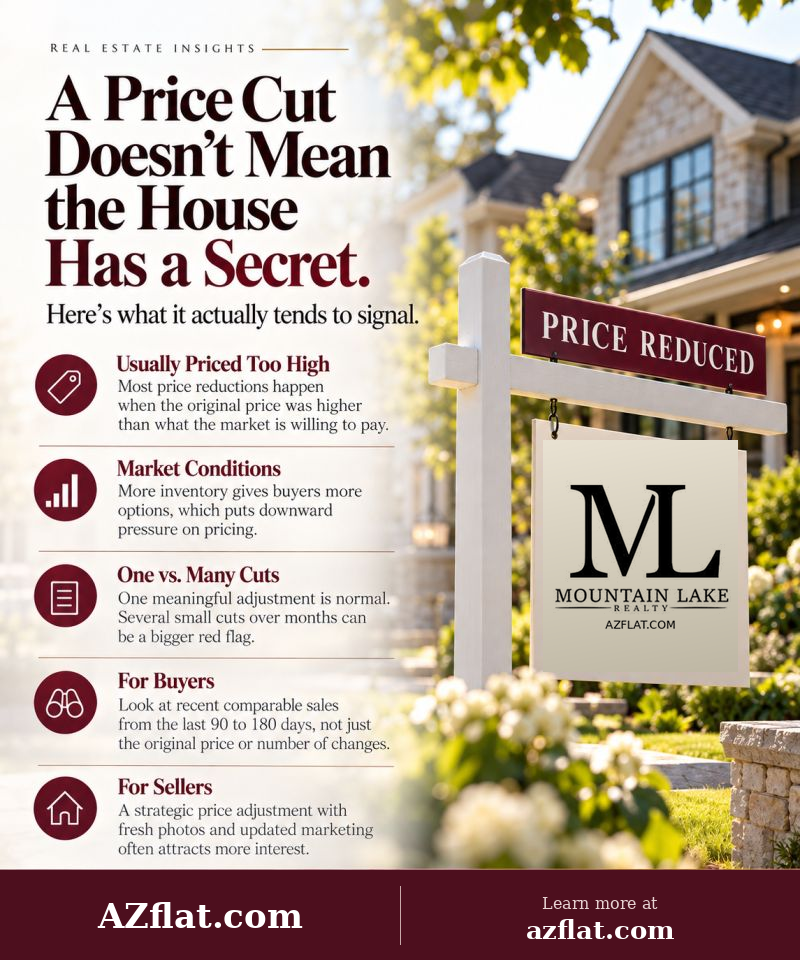
A thoughtful, early adjustment can be a smart strategy. Markets change, competing listings appear, and sometimes a seller's first price needs recalibration. The issue is not the reduction itself. The issue is letting a listing linger without a plan.
Repeated reductions can cause buyers to wonder why the home has not sold. Some buyers may wait, expecting another cut. Others may assume there is a condition problem, even when the only issue was the original asking price.
In May 2026, 75% of homes that sold had already reduced their original asking price, according to the local data summarized by ARMLS and The Cromford Report. The reported median reduction was $25,000. That is a meaningful reminder that a high starting price does not necessarily protect your outcome; it can lead to a larger correction later.
How to price your Arizona home with confidence
A strong pricing decision is based on evidence, not on what a neighbor asks or what you hope to net. Start by reviewing recent comparable sales, then weigh the current listings that buyers will see alongside your home.
Use recent, relevant sold comparables
Look for homes that sold recently in your immediate area and are similar in size, condition, lot, layout, and amenities. In Arizona, details such as a pool, view lot, upgraded kitchen, three-car garage, solar system, and outdoor living space can materially affect value.
The goal is not to find the highest sale. It is to identify the range supported by homes that a buyer would genuinely consider comparable to yours.
Review your active competition
Sold homes explain where the market has been. Active listings show what buyers can choose today. Review comparable homes that are pending, newly listed, and sitting on the market. A home that has been active for months may be a sign of where the market will not go.
Choose a strategy, not just a number
Your timing, condition, and goals matter. A move-in-ready home in a desirable neighborhood may benefit from a price designed to draw broad interest. A home needing updates may need to account for the buyer's renovation budget from the start.
Be clear about the result you want: the fastest possible sale, the strongest chance of multiple offers, or a price that allows more time for a specific buyer. A good strategy makes that tradeoff intentional.
Watch the feedback after launch
Track showings, online engagement, agent comments, and competing inventory. If buyers are looking but not booking appointments, the price or presentation may be outside expectations. If they tour but do not offer, the condition, price, or both may need another look.
Price right from day one
The strongest sellers do not leave money on the table by pricing realistically. They position their home where qualified buyers can find it, compare it favorably, and act with confidence. That can mean more showings, better negotiating leverage, and a cleaner path to closing.
Dash List provides Arizona sellers with a Price Valuation CMA to help establish a market-supported strategy before a listing goes live. When you pair smart pricing with broad MLS exposure, you give your home a better opportunity to attract the buyers it deserves.
The psychology of overpricing — and why sellers do it
Understanding why sellers overprice helps you avoid the trap.
Anchoring to the purchase price. Many sellers anchor their expectations to what they paid for the home, plus what they have invested in improvements. The market does not care what you paid. Buyers compare your home to other available options at the same price point.
Emotional attachment. You have lived in this home, raised a family, made memories. That emotional value is real — but it is not something buyers will pay for. Buyers are making a financial decision based on comparable sales and current market conditions.
Listening to the wrong advice. Some sellers choose the agent who suggests the highest price, rather than the agent who provides the most accurate analysis. This is called "buying the listing" — an agent suggests an inflated price to win the listing, knowing they will recommend a price reduction later.
Fear of leaving money on the table. Sellers worry that if they price too low, they will sell for less than they could have gotten. In reality, a well-priced home often attracts multiple offers and sells at or above asking price. An overpriced home attracts no offers.
How to price your Arizona home correctly
Start with a comparative market analysis. A CMA compares your home to similar homes that have recently sold in your neighborhood. It accounts for size, condition, location, and features. It is not a guarantee of what your home will sell for, but it gives you a data-based starting point.
Focus on the last 60–90 days. Older sales may not reflect current market conditions. In a shifting market, a sale from 12 months ago may be significantly above or below current values.
Adjust for condition and features. If your home has been recently renovated, it may justify a premium over comparable sales. If it needs work, it should be priced accordingly.
Look at active competition. Your home is not just competing with recent sales — it is competing with every other home currently on the market in your price range. If competing homes are offering more for the same price, buyers will choose them.
Price to attract showings in the first two weeks. The first two weeks of a listing generate the most activity. A price that attracts showings and offers in that window is almost always better than a higher price that generates no activity.
What to do if your home is already overpriced
If your home has been on the market for more than 30 days without an offer, it is likely overpriced. Here is what to do:
Make a meaningful price reduction. A $5,000 reduction on a $450,000 home is not meaningful. Buyers will not notice it. A $15,000–$20,000 reduction resets buyer interest and can generate new showings.
Do not make multiple small reductions. Each small reduction signals to buyers that the home is problematic and that the seller is desperate. One meaningful reduction is better than three small ones.
Reassess the competition. Pull up the current active listings in your price range and compare. If competing homes have improved or new listings have come on the market, you may need to price more aggressively.
Consider a temporary withdrawal. In some cases, withdrawing the listing for 30 days and relaunching at a corrected price can reset the days-on-market counter and generate fresh buyer interest.
Ready to list your Arizona home?
Dash List Team offers flat fee MLS listing starting at $59 upfront and 0.5% at closing — full MLS exposure, professional photography, Zillow Showcase, and contract support included.
View pricing and packages · How it works · Get a free consultation
Serving sellers across Phoenix, Scottsdale, Tucson, Mesa, Chandler, Gilbert, and all Arizona cities.
Explore Topics
Written by
Thomas Mastromatto
Content creator and writer sharing insights and stories.