How Much Should I Reduce My Home Price After 30 Days?
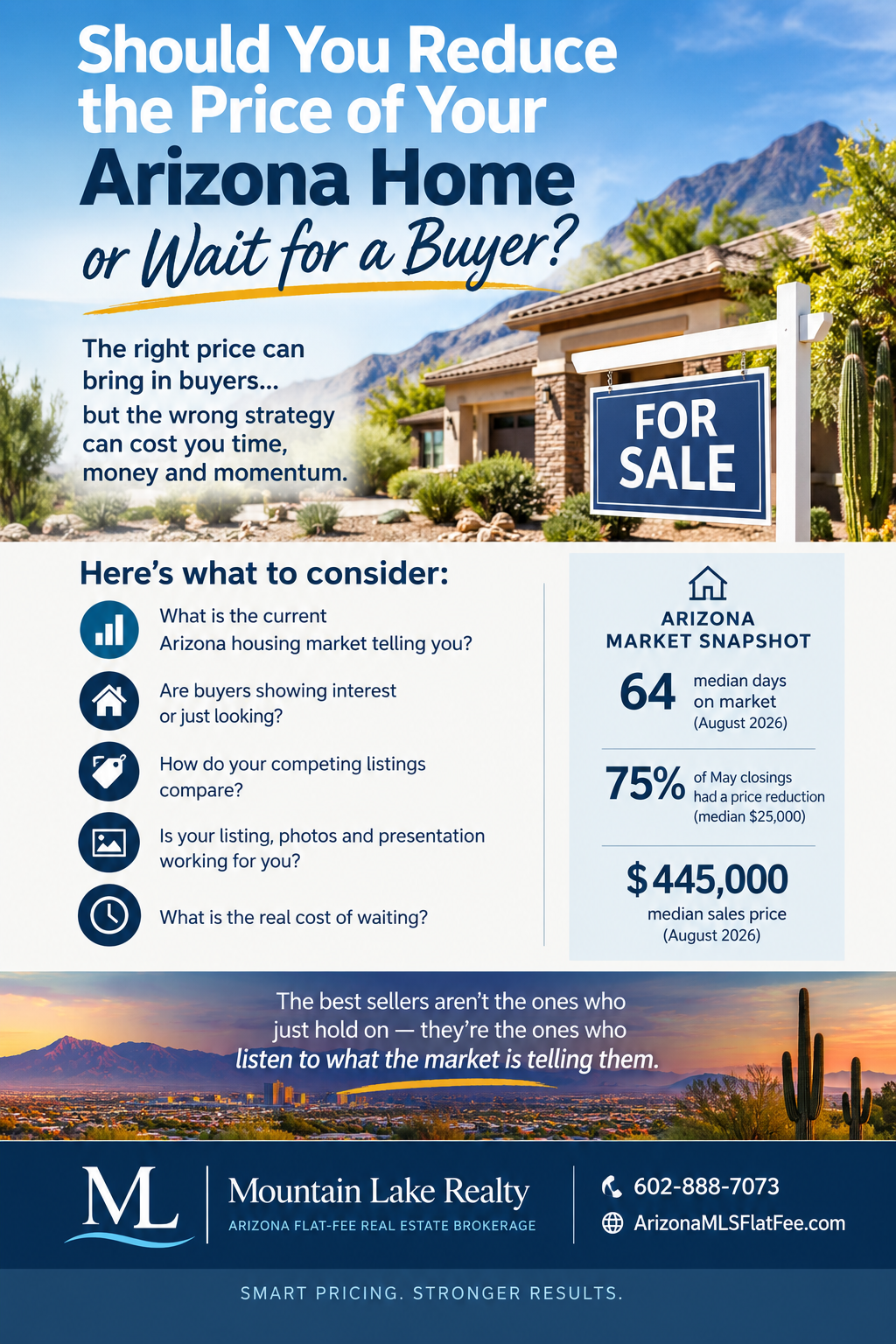
Your Arizona home has been on the market for 30 days with no offers. How much should you cut the price — and when? Here is what the ARMLS data says.

Your home has been on the market for 30 days. You have had some showings, maybe a few second looks, but no offers. Your agent — or your gut — is telling you it might be time to reduce the price.
How much should you cut? When should you do it? And is there a way to avoid this situation entirely?
Here is what the data from ARMLS (Arizona Regional Multiple Listing Service) and real-world Arizona transactions tell us.
The Hard Truth: Waiting to Reduce Costs You More
Before we get into the numbers, let's address the most common mistake Arizona sellers make: waiting too long to reduce.
The logic sellers use is understandable. "Let's give it another two weeks." "Maybe the right buyer just hasn't seen it yet." "I don't want to look desperate."
But here is what the data shows: the longer a home sits on the market, the lower the final sale price — even after a reduction.
A home that sells in the first 14 days typically sells at or very close to list price. A home that sells after 60 days typically sells for 3–6% below its final list price — which itself may already be 3–5% below the original list price. The cumulative discount can be 6–10% below where you started.
That is not a small number. On a $450,000 home, a 7% cumulative discount is $31,500.
Waiting to reduce does not protect your price. It erodes it.
What "30 Days With No Offers" Actually Means
If your home has been on the market for 30 days in the current Arizona market with no offers and limited showing activity, the market is telling you something specific: your price is above what buyers are willing to pay.
This is not about the market being bad. Homes are still selling in Arizona. It is about your price relative to comparable homes that buyers can choose instead.
The question is not whether to reduce. The question is how much — and how to do it in a way that generates momentum rather than just signaling desperation.
How Much to Reduce: The ARMLS Framework
There is no universal number, but here is a practical framework based on Arizona market data:
If you have had showings but no offers:
Buyers are interested enough to visit but not interested enough to write. This usually means you are 3–5% above market. A reduction in that range — done decisively and announced clearly — typically restarts activity.
On a $450,000 home: a $13,500–$22,500 reduction.
If you have had very few showings:
Low showing volume means buyers are not even clicking through to schedule. This is a more serious pricing problem — you are likely 5–8% or more above market. A small reduction will not fix it. You need a meaningful cut that moves you into a different buyer search range.
On a $450,000 home: a $22,500–$36,000 reduction.
If you have had no showings at all:
This is a red flag. Either your price is dramatically above market, your listing has a presentation problem (poor photos, bad description), or both. Before reducing, audit your listing quality. If the presentation is solid, you need a significant price adjustment — potentially 8–12%.
The Psychology of Price Reductions
Here is something most sellers do not consider: how you reduce matters as much as how much you reduce.
A series of small reductions — $5,000 here, $3,000 there — signals to buyers that you are reluctant and may reduce again. Buyers wait. They do not want to be the person who bought right before the next cut.
A single, decisive reduction signals that you have reassessed the market and are serious about selling. It creates urgency. Buyers who passed on your home the first time will take a second look.
One meaningful reduction beats three small ones every time.
The Price Bracket Effect
In Arizona, buyers search by price brackets — typically in $25,000 or $50,000 increments. If your home is listed at $427,000, you are missing buyers who are searching up to $400,000 and competing against homes priced at $425,000 that show up in the same search.
When you reduce, consider whether dropping to a round number or a bracket threshold will meaningfully expand your buyer pool. Sometimes a $2,000 reduction to hit $424,900 matters less than a $27,000 reduction to $399,900 that puts you in front of an entirely new set of buyers.
What to Do Before You Reduce
Before cutting your price, make sure the price is actually the problem. Run through this checklist:
Photography. Are your listing photos professional quality? Shot in good light? Showing the home at its best? Poor photos can suppress showings even at a fair price.
MLS exposure. Is your home on ARMLS? Is it syndicating to Zillow, Realtor.com, Trulia, and Homes.com? If you listed with a service that does not provide full MLS exposure, you may have a distribution problem, not a price problem.
Condition. Did buyers who visited give feedback about condition issues? Deferred maintenance, odors, or clutter can kill deals that price alone cannot fix.
Comparable sales. Pull the last 60–90 days of closed sales for comparable homes in your neighborhood. Not list prices — closed prices. That is your actual market. If your price is within 2–3% of those comps, the problem may not be price.
If all of those check out and you still have no offers after 30 days, reduce — decisively and promptly.
The Cost of Waiting: A Real Example
Let's say your home is listed at $475,000. After 30 days, no offers. You decide to wait another 30 days before reducing.
- Carrying costs for 30 days (mortgage, taxes, insurance): approximately $2,800–$3,500
- Final sale price after 60 days on market vs. 14 days: typically 2–4% lower
- On $475,000, that is $9,500–$19,000 less at closing
You waited 30 days to avoid reducing by $10,000 — and ended up netting $12,000–$22,000 less than if you had reduced promptly at day 30.
Waiting to reduce is almost never the right financial decision.
How Dash List Helps You Price Right From Day One
The best price reduction strategy is not needing one.
Dash List at Mountain Lake Realty provides every seller with a free Comparative Market Analysis before listing — a real CMA based on actual ARMLS closed sales, not an automated estimate. We help you price accurately from day one so your home generates activity in the first two weeks, not the first two months.
And because our flat fee starts at $99 upfront plus 0.5% at closing, your break-even point is lower. You can price more competitively and still net more than you would have with a traditional 3% listing commission.
The Bottom Line
If your Arizona home has been on the market for 30 days with no offers, the market is giving you clear feedback. Do not ignore it. Do not make a token reduction. Make a meaningful, decisive cut — ideally to a price bracket that opens your home to a new pool of buyers — and do it now.
The data is consistent: sellers who reduce promptly and decisively net more than sellers who wait. Every week you delay is a week of carrying costs and a week of buyer perception working against you.
Price it right. List it with full MLS exposure. Sell it faster and net more.
The psychology of price reductions — and how to do them right
Price reductions are not a sign of failure. They are a market correction — an acknowledgment that the initial price was above what buyers are willing to pay. The sellers who handle price reductions well are the ones who act decisively and frame the reduction correctly.
How to announce a price reduction
When you reduce your price, the MLS automatically flags the listing as "Price Reduced." This can attract buyers who have been watching the listing and waiting for a price adjustment. To maximize the impact:
Time the reduction strategically. A Thursday or Friday reduction gives the listing a fresh start heading into the weekend, when buyer activity is highest.
Make the reduction meaningful. A $5,000 reduction on a $450,000 home is not meaningful. Buyers will not notice it. A $15,000–$20,000 reduction resets buyer interest and can generate new showings.
Update the listing description. A price reduction is an opportunity to refresh the listing. Update the description, add new photos if available, and make sure the listing is presenting the home in the best possible light.
Be prepared for renewed activity. A meaningful price reduction often generates a burst of showing activity in the first week. Be ready to accommodate showings and respond to offers quickly.
The cost of waiting to reduce
Every week you delay a necessary price reduction costs you:
- Carrying costs: Mortgage interest, taxes, insurance, and maintenance continue to accumulate.
- Days on market: Each additional day on market signals to buyers that something may be wrong with the property.
- Buyer perception: Buyers who have seen your listing multiple times without making an offer may assume the home has problems.
- Negotiating position: A home that has been on the market for 90+ days is in a weaker negotiating position than a home that is new to the market.
The math is straightforward: a $15,000 price reduction in week 3 is almost always better than a $20,000 price reduction in week 10, after you have paid $7,000–$10,000 in additional carrying costs.
When a price reduction is not the answer
Sometimes a price reduction is not the right solution. If buyers are visiting but not making offers, the issue may be condition rather than price. In that case:
- Get specific feedback from buyers' agents about what they are seeing
- Address the specific issues buyers are raising (deferred maintenance, outdated finishes, cleanliness)
- Consider a targeted improvement that addresses the most common objection
A $5,000 investment in fresh paint and new carpet may be more effective than a $15,000 price reduction if condition is the issue.
Ready to list your Arizona home?
Dash List Team offers flat fee MLS listing starting at $59 upfront and 0.5% at closing — full MLS exposure, professional photography, Zillow Showcase, and contract support included.
View pricing and packages · How it works · Get a free consultation
Serving sellers across Phoenix, Scottsdale, Tucson, Mesa, Chandler, Gilbert, and all Arizona cities.
Explore Topics
Written by
Dash List Team at Mountain Lake Realty
Content creator and writer sharing insights and stories.